We have analysed billions of searches in order to better understand the evolution of search from desktop to mobile devices. The result: mobile search is already much more important than you previously thought. Let's look at the analyses straight away:
The number of daily searches performed from a phone continues to grow, while searches from a mobile phone continue to increase. desktop and laptop computers are stagnating. If you only have limited time, here are the most important findings:
In March, Google changed its search index from Mobile First to Mobile First. Mobile Only (Google ad). Websites, the desktop version of which was previously being tracked, were only recorded with the mobile version in the future.
Google is taking this step, because the The vast majority of all searches are now conducted on mobile devices.. The number of desktop searches is stagnating, while the number of smartphone searches continues to grow.
While this is a perfectly logical step for Google, a considerable part of the SEO and online marketing sector is still stuck in the desktop world. We work on large screens in our day-to-day work, and we take decisions based on data from desk.
To demonstrate the importance of mobile search queries today, we have carried out an in-depth analysis with some of the most popular mobile search queries in the world. 80 million keywordsand many billions of search queries. The results are striking.
To get to the heart of the matter, we conducted an initial study of how many more keywords are in desktop as opposed to mobile searchesThe same comparison is made in reverse, and finally, for how many keywords this ratio is more or less balanced. The result is surprising:

It is clear: out of the 84,637,700 keywords analysed, only one 27% of searches carried out since desktop prevail over mobile queries. For these keywords, queries from desktop devices make up 55% of the total, while from mobile devices they reach a maximum of 45%.
On the other hand, the proportion of terms for which mobile searches have keyword weight is more than double: almost 57% of all these keywords are mobile searches, of which the majority come from the mobile device. Around 15% of all keywords are more or less equally distributed across all devices.
The first thing to bear in mind: a keyword levelthe mobile device is doubly important compared to desktop.
In order not to have a single benchmark, in the following analysis we look at this topic from a different point of view. Now we will not measure individual keywords, but look at all queries as a whole: what device is being searched for? The answer:

Here, too, the answer is clear: only about 35% of all searches are performed from a desktop device.. All the others, and therefore almost twice as many searches, come from mobile devices.
Thus, the second piece of information also confirms our findings in the first analysis: in telephones mobiles is carried out on double the number of searches that in computers desktop.
To conclude this analysis, let's look at the different sectors. For the assessment presented below, we have analysed key terms from leading domains in their respective areas.
The data obtained show how large the share of mobile and desktop searches in many known sectors and themes:
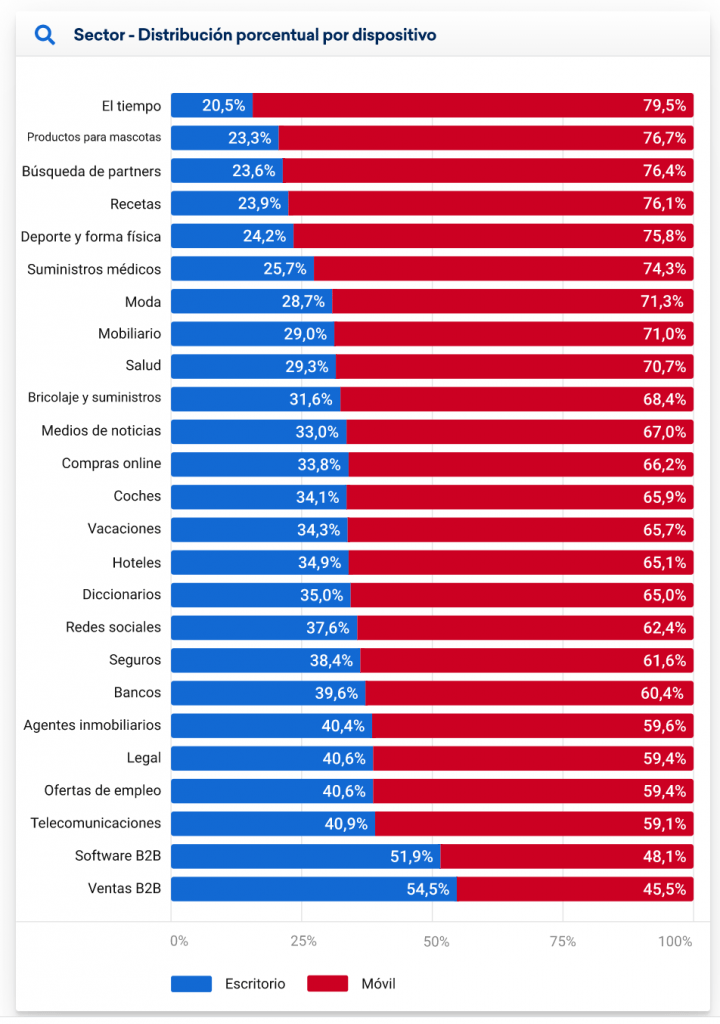
The result: huge differences. While only one in five consultations on the weather forecast on Google comes from a desktop device, the situation is completely different when it comes to B2B topicsDesktop searches are still the majority in this case.
On the other hand, there are sectors where the mobile consultation ratio is still considerably below average. These are the job vacanciesas well as websites whose central theme is the telecommunications.
In order to demonstrate the existence of sectors in which the mobile searches still do not account for the majority of all queriesWe have included purely B2B themes: B2B software such as Salesforce or Hubspot, as well as B2B websites The number of searches for recruitment and commerce nowadays is even higher on desktop than on mobile.
For us, the latest data dictates that no general statement can be made about the relevance of mobile searches. The distribution can be very varied, depending on the sector contemplated.
It's great that you've made it this far! You now have a much deeper and greater understanding of the status quo of mobile searches on Google. But it is now that it really gets interesting: the theory should lead to the analysis, and the actions corresponding.
You should now be able to cross out or respond to the The following points about your website, to be well prepared for the mobile future:
And that's all about the difference between mobile and desktop search, the relevance of mobile queries and your next steps. Before we go, here's a suggestion: if you are not yet a customer of ZapiplayI recommend contact us.
We have recently implemented many new features related to mobile search relevance: completely new and revised keyword functionsThe integration of the Core Web Vitals, and a general approach from a mobile-first perspective. It is worthwhile.